

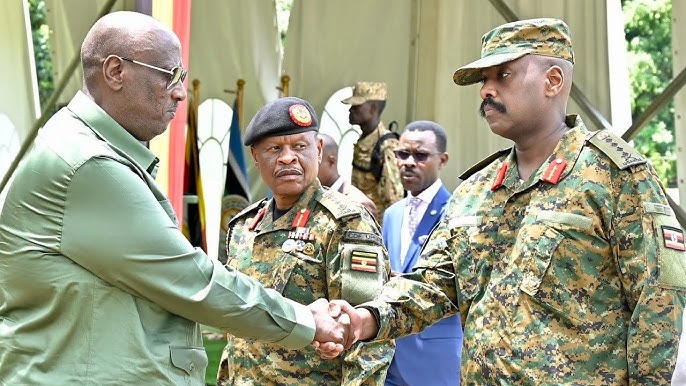
KAMPALA, Uganda — As President Yoweri Museveni, now in power for nearly four decades, consolidates his seventh term following the disputed 2026 elections, a quiet but intense discussion has emerged within political and military circles: Who might succeed him? Much of the public spotlight has focused on Gen. Muhoozi Kainerugaba, Museveni’s son and army chief, but another heavyweight figure Gen. Caleb Akandwanaho, commonly known as Salim Saleh — is increasingly part of the conversation.
Muhoozi: The Front‑Runner — But Who Really Backs Him?
Gen. Muhoozi Kainerugaba has been widely seen as the most obvious heir to Museveni’s leadership role, having risen rapidly through military ranks and wielding influence over key security institutions. Ahead of the 2026 election, he played a central role in directing the army and security forces including controversial moves against opposition figures and has been described by analysts as tightening his grip on power.
His support base within the military is strong especially among younger colonels and major generals who see him as a continuation of the current leadership’s trajectory. One senior officer said that “80 percent” of middle‑ranking officers back Muhoozi, in part because a leadership shift toward him would likely preserve their positions or bring further rewards.
Yet this support is not universal. News reports indicate that some older military elites and senior officers are displeased with Muhoozi’s style, particularly his frequent controversial social media posts, which have sparked diplomatic concerns and internal disagreements. There have also been reports that figures like Salim Saleh have publicly intervened in the past to moderate or “rein in” his conduct, particularly when it drew criticism from international partners.
Salim Saleh: The Behind‑the‑Scenes Power Broker
Gen. Salim Saleh does not command the same public visibility as Muhoozi, nor has he formally declared political ambitions. But his networks within the military establishment and political circles run deep.
Saleh’s career began alongside Museveni in the early rebel movements that brought their government to power. Over decades, he has worn many hats from senior military commander to presidential adviser and key figure in development initiatives such as Operation Wealth Creation. Through these roles, he has cultivated relationships across regions, among military leaders, and within economic and political elites.
While Saleh’s influence is more subtle and less headline‑driven than Muhoozi’s, that very discretion can be a strength. In political environments marked by fragile elite coalitions, figures who can build consensus behind the scenes often become kingmakers or compromise candidates during transitions. Analysts have noted that although Museveni’s son dominates public narratives about succession, access to authority in Uganda frequently operates through networks rather than office titles alone.
A critical fault line in succession discussions is generational and institutional preference. Younger officers, often aligned with Muhoozi’s vision of continuity and modernisation, may favour him. But older generals — those who fought in the bush war and helped shape the current state — often wield outsized informal influence, including in power transitions. They tend to value experience, stability, and reputation over social media presence or rapid ambition. This cohort may be more receptive to a Saleh figure, whose career intersects military service, political negotiation, and development initiatives.
Indeed, observers have described Saleh’s role in several diplomatic and internal communications as that of a moderator in the system. His involvement in sensitive discussions — including with foreign diplomats concerned about internal military conduct — shows how he operates at the nexus of power and reputation.
Comparing Profiles: Muhoozi vs. Saleh
| Factor | Muhoozi Kainerugaba | Salim Saleh |
| Public Visibility | Very high; active on social media and in political discussions | Lower; works behind the scenes |
| Military Support Base | Strong among younger officers and parts of UPDF | Strong ties with seasoned officers and establishment figures |
| Leadership Style | Assertive and outspoken | Measured, consensus‑oriented |
| Political Ambition | Widely interpreted as a potential successor | Not publicly declared as seeking presidency |
| International Perception | Controversial due to posts and rhetoric | Seen as more diplomatic and stabilising |
What This Means for Succession
