
Close Menu
  • Home
  • Mukono News
  • Nakifuma
  • National
  • Entertainment
  • Gospel News
  • Sports

Subscribe to Updates

Get the latest creative news from Mukuno.

Facebook X (Twitter) Instagram
Facebook X (Twitter) Instagram Vimeo
Mukono News
Saturday, March 14
  • Home
  • Mukono News
  • Nakifuma
  • National
  • Entertainment
  • Gospel News
  • Sports
Mukono News
  • Home
  • Advertise With Us
  • Contact Us
Home » Could Gen. Salim Saleh Be Uganda’s Next President? A Look Beyond the Headlines
Opinion

Could Gen. Salim Saleh Be Uganda’s Next President? A Look Beyond the Headlines

Nyanzi LiveBy Nyanzi LiveFebruary 6, 2026Updated:February 6, 2026No Comments6 Mins Read39 Views
Share this Facebook Twitter WhatsApp Email
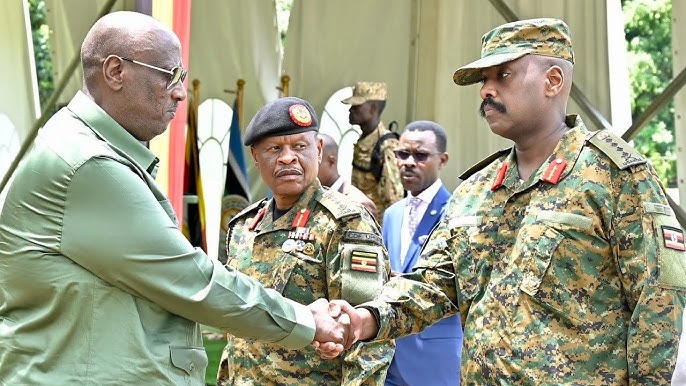
Salim Saleh
Facebook Twitter WhatsApp Copy Link Email

KAMPALA, Uganda — As President Yoweri Museveni, now in power for nearly four decades, consolidates his seventh term following the disputed 2026 elections, a quiet but intense discussion has emerged within political and military circles: Who might succeed him? Much of the public spotlight has focused on Gen. Muhoozi Kainerugaba, Museveni’s son and army chief, but another heavyweight figure  Gen. Caleb Akandwanaho, commonly known as Salim Saleh — is increasingly part of the conversation.

Muhoozi: The Front‑Runner — But Who Really Backs Him?

Gen. Muhoozi Kainerugaba has been widely seen as the most obvious heir to Museveni’s leadership role, having risen rapidly through military ranks and wielding influence over key security institutions. Ahead of the 2026 election, he played a central role in directing the army and security forces  including controversial moves against opposition figures and has been described by analysts as tightening his grip on power.

His support base within the military is strong  especially among younger colonels and major generals who see him as a continuation of the current leadership’s trajectory. One senior officer said that “80 percent” of middle‑ranking officers back Muhoozi, in part because a leadership shift toward him would likely preserve their positions or bring further rewards.

Yet this support is not universal. News reports indicate that some older military elites and senior officers are displeased with Muhoozi’s style, particularly his frequent controversial social media posts, which have sparked diplomatic concerns and internal disagreements. There have also been reports that figures like Salim Saleh have publicly intervened in the past to moderate or “rein in” his conduct, particularly when it drew criticism from international partners.

Salim Saleh: The Behind‑the‑Scenes Power Broker

Gen. Salim Saleh does not command the same public visibility as Muhoozi, nor has he formally declared political ambitions. But his networks within the military establishment and political circles run deep.

Saleh’s career began alongside Museveni in the early rebel movements that brought their government to power. Over decades, he has worn many hats from senior military commander to presidential adviser and key figure in development initiatives such as Operation Wealth Creation. Through these roles, he has cultivated relationships across regions, among military leaders, and within economic and political elites.

While Saleh’s influence is more subtle and less headline‑driven than Muhoozi’s, that very discretion can be a strength. In political environments marked by fragile elite coalitions, figures who can build consensus behind the scenes often become kingmakers  or compromise candidates during transitions. Analysts have noted that although Museveni’s son dominates public narratives about succession, access to authority in Uganda frequently operates through networks rather than office titles alone.

A critical fault line in succession discussions is generational and institutional preference. Younger officers, often aligned with Muhoozi’s vision of continuity and modernisation, may favour him. But older generals — those who fought in the bush war and helped shape the current state — often wield outsized informal influence, including in power transitions. They tend to value experience, stability, and reputation over social media presence or rapid ambition. This cohort may be more receptive to a Saleh figure, whose career intersects military service, political negotiation, and development initiatives.

Indeed, observers have described Saleh’s role in several diplomatic and internal communications as that of a moderator in the system. His involvement in sensitive discussions — including with foreign diplomats concerned about internal military conduct — shows how he operates at the nexus of power and reputation.

Comparing Profiles: Muhoozi vs. Saleh

Factor Muhoozi Kainerugaba Salim Saleh
Public Visibility Very high; active on social media and in political discussions Lower; works behind the scenes
Military Support Base Strong among younger officers and parts of UPDF Strong ties with seasoned officers and establishment figures
Leadership Style Assertive and outspoken Measured, consensus‑oriented
Political Ambition Widely interpreted as a potential successor Not publicly declared as seeking presidency
International Perception Controversial due to posts and rhetoric Seen as more diplomatic and stabilising

What This Means for Succession

In that sense, Saleh’s role as a bridge between old and new elites, and his perceived ability to calm or unify factions, could make him an influential figure in shaping who eventually leads Uganda.

Administrative competence and trust now sit at the heart of the succession debate. Several analysts argue that while Gen. Muhoozi Kainerugaba commands immense institutional power under the UPDF Establishment 2024, his strengths lie firmly in military command rather than public administration or civilian political management. His confrontational communication style, particularly on social media, and strained relations with diplomatic partners have raised questions about his suitability for the consensus-building demands of the presidency.

By contrast, Gen. Salim Saleh is widely regarded within the establishment as an administrative stabilizer and compromise builder. His long involvement in government programmes, advisory roles and behind-the-scenes mediation has given him a reputation for managing competing interests quietly a skillset that aligns more closely with civilian governance than battlefield command.

Ironically, the very powers Gen. Muhoozi holds as Chief of Defence Forces may reduce his incentive to seek the presidency. Under the 2024 Establishment, the CDF exercises extensive authority over the UPDF’s operations, promotions, deployments, intelligence coordination and joint staff administration  powers that, in practice, rival those of a head of state in matters of security and coercive force. Some observers argue that this concentration of authority places Muhoozi in a position where formal political office may offer fewer additional advantages than expected.

This reality feeds into a deeper trust question within elite circles: if Muhoozi were to become president, who would control the military powers he currently holds as CDF? The concern is not merely constitutional, but practical whether the transfer of such concentrated authority could destabilize carefully balanced relationships within the UPDF and the wider state.

Conversely, a scenario in which Salim Saleh assumes the presidency could preserve institutional equilibrium. In such an arrangement, analysts suggest, Muhoozi would likely remain content retaining the CDF position and its vast operational influence, while Saleh provides civilian leadership marked by negotiation, reassurance and continuity. For sections of the establishment, this division of labor appears less risky than a wholesale consolidation of both military and civilian power in one individual.

Ultimately, Uganda’s succession question may hinge less on popularity or lineage than on trust — trust in who can manage power without unsettling the system, and who can hold authority without provoking resistance at home or concern abroad.

ALSO READ: Nyanzi Isimah (Nyanzi Live): From Grassroots Radio to a Recognised Media and Digital Voice

2026 Uganda Elections civil-military relations Elite Politics Military Influence in Politics Muhoozi Kainerugaba National Resistance Movement Political Succession Post-Election Politics Power Transition Presidential Succession Salim Sahel for president of Uganda Salim Saleh Uganda Governance Uganda politics UPDF Yoweri Museveni
Share. Facebook Twitter Pinterest LinkedIn Tumblr WhatsApp Email
Previous ArticleJoseph Mulwana defeats incumbent Mulindwa James in tense Kasawo mayoral race
Next Article Former Candidate Kasibante Withdraws Presidential Election Petition
Nyanzi Live
  • Website

Nyanzi Live is a Ugandan radio presenter on 93.0 Kingdom FM, a writer, political analyst, and digital marketer. He has worked across radio, print, and digital media, with experience at Sauti FM, Success FM, and as a contributor to the Luganda newspaper Ssekanolya. His work focuses on media, politics, and contemporary Ugandan issues.

Related Posts

Why Bobi Wine Trusted Lina Zedriga to Act as NUP President Amid Leadership Vacuum

March 14, 2026 Opinion By Nyanzi Live37 Views

Court Intern Gloria Laker Remanded Over Alleged Sharing of Bobi Wine Case Records.

March 14, 2026 Politics By Nyanzi Live68 Views

Breaking: Parliament withdraws Lumu Bill after mover tables motion.

March 12, 2026 National By Nyanzi Live25 Views

AIGP James Ochaya opens up on when police will leave Bobi Wine’s house and what awaits his return

March 10, 2026 National By Nyanzi Live34 Views
Leave A Reply Cancel Reply

WEB
Our Picks
  • Facebook
  • Twitter
  • Instagram
  • YouTube
Don't Miss
Opinion

Why Bobi Wine Trusted Lina Zedriga to Act as NUP President Amid Leadership Vacuum

By Nyanzi LiveMarch 14, 20260 Opinion 37 Views

The decision by Robert Kyagulanyi Ssentamu, popularly known as Bobi Wine, to appoint Lina Zedriga…

Iran’s New Supreme Leader Reportedly Wounded Amid Ongoing U.S.–Israel Strikes.

March 14, 2026

UNEB Reports Improved Performance in Biology, Mathematics and Chemistry in 2025 UACE Results.

March 14, 2026

Court Intern Gloria Laker Remanded Over Alleged Sharing of Bobi Wine Case Records.

March 14, 2026

Subscribe to Updates

Get the latest creative news from SmartMag about art & design.

Mukono News
Facebook X (Twitter) Instagram Pinterest WhatsApp
  • Home
  • Advertise With Us
  • Contact Us
© 2026 Mukono News. Designed by Enosoft Blogger.

Type above and press Enter to search. Press Esc to cancel.