

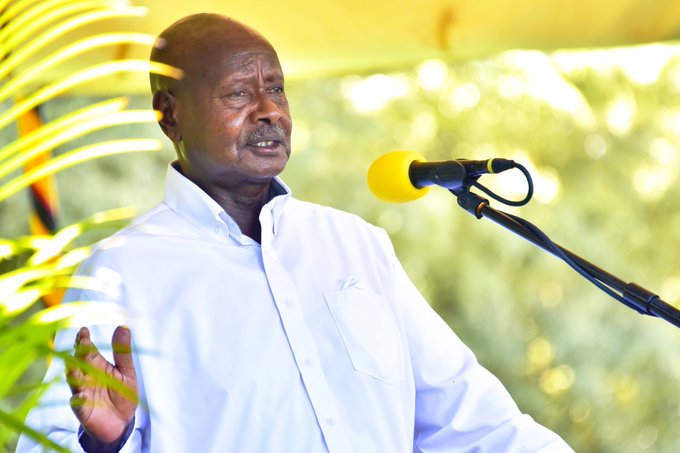
President Yoweri Museveni on Thursday issued a detailed letter to Ugandans reflecting on the January 15, 2026 presidential election, its outcome and the future direction of the country. The message comes amid ongoing debate over the conduct of the polls and the political landscape going into Museveni’s seventh term in office.
In the message widely shared across social media and local news platforms, Mr Museveni acknowledged the results published by the Electoral Commission of Uganda, in which he was officially declared the winner of the national vote. According to the final tally, Museveni, 81, secured 7,946,772 votes equivalent to 71.65 per cent of valid ballots cast to extend his nearly 40-year rule with a seventh five-year term.
His closest challenger, Robert Kyagulanyi Ssentamu, popularly known as Bobi Wine, finished second with 2,741,238 votes (24.72 per cent). Other candidates trailed far behind, including Nathan Nandala Mafabi of the Forum for Democratic Change (FDC) with 209,039 votes (1.88 per cent) and Mugisha Muntu of the Alliance for National Transformation (ANT) with 59,276 votes (0.53 per cent).
In his letter, Museveni emphasised the continued relevance of the ruling National Resistance Movement (NRM) and defended its electoral performance, asserting that his administration maintains significant popular support nationwide. He reiterated that despite what he described as “unaddressed mass challenges” — including issues in education, infrastructure, health and corruption — voters had shown confidence in his leadership.
EU Parliament Condemns Uganda’s January 2026 Polls, Demands Release of Bobi Wine, Besigye
The President also highlighted the role of the controversial Biometric Voter Verification Kits (BVVK) in strengthening the integrity of the election, even as technical failures forced many polling stations to revert to manual voter lists. “With the BVV machines, the Opposition’s lifeline of cheating was gone,” Museveni wrote, according to the report.
Official figures published by the Electoral Commission indicate that approximately 11,366,201 Ugandans cast ballots, translating to a turnout of around 52.5 per cent of the 21.6 million registered voters — the lowest participation rate recorded in decades.
The election was held against a backdrop of heightened tension and restrictions on digital communications, with the government imposing a nationwide internet blackout day before voting. Critics — including opposition parties and international rights groups — argued this hindered transparency and observation.
Bobi Wine and the National Unity Platform (NUP) have rejected the results, dismissing them as fraudulent and inconsistent with what transpired at polling stations. The party has cited irregularities, including voter intimidation and alleged militarised responses in some areas.
Wine’s personal situation remains fluid: he went into hiding shortly after the polls closed amid reports of an army presence around his home, and his whereabouts became a matter of national and international attention.
Analysts say Museveni’s letter seeks to shape the narrative of national unity following a disputed election cycle and to pre-empt legal and political challenges ahead of his inauguration. By acknowledging both the electoral outcome and extant governance challenges, the President appears to be positioning his administration for continued control of Uganda’s political agenda
ALSO READ: EU Parliament Condemns Uganda’s January 2026 Polls, Demands Release of Bobi Wine, Besigye
