

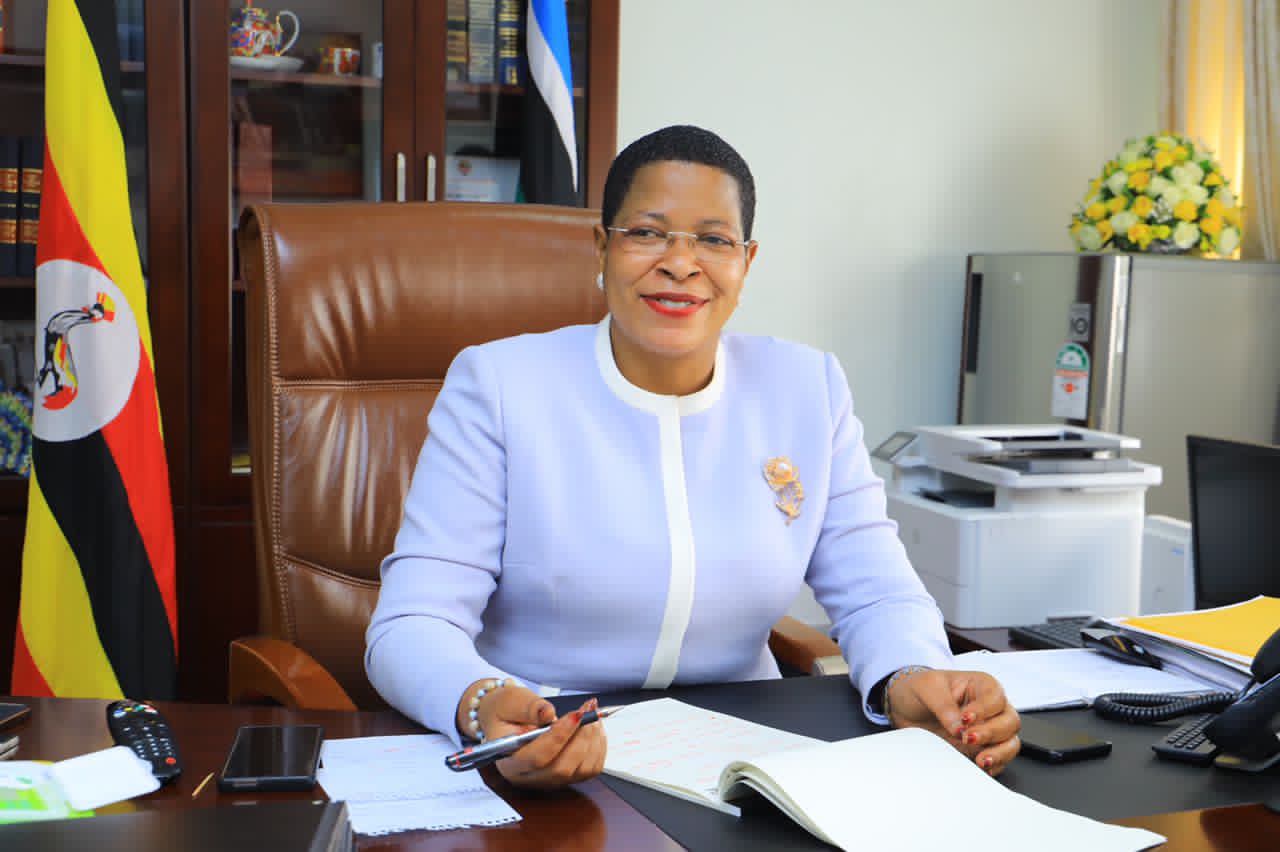
In what many observers have described as a surprising and unusual move, Anita Annet Among, the Speaker of Parliament, publicly declared that she has no ambition to run for President, a statement that has sparked widespread debate across Uganda’s political landscape.
Speaking in a candid tone, Among went further to cast doubt on her own suitability for the country’s top office, remarking that she considers herself unfit for such a role. In a striking comment that caught public attention, she said she does not even know how to operate a gun—an assertion many interpreted as symbolic in a country where military credentials have historically been linked to political power.
The unexpected nature of her remarks has left political analysts and observers questioning what may have prompted such a strong and public disclaimer. While some view it as a straightforward personal position, others believe it reflects deeper undercurrents within Uganda’s ruling establishment.
A section of commentators argues that the statement is a calculated response to growing speculation surrounding Among’s political ambitions. In recent months, her rising influence and reported accumulation of wealth have placed her under increasing scrutiny, both within the ruling National Resistance Movement (NRM) and the broader political sphere.
According to this interpretation, Among’s declaration may have been intended to distance herself from any perception that she could pose a challenge to President Yoweri Museveni or his son, Muhoozi Kainerugaba. By explicitly ruling out presidential ambitions, she appears to signal loyalty rather than rivalry within the inner circles of power.
The timing of her statement has further fueled speculation. Prior to her remarks, Andrew Mwenda—widely perceived as being close to Muhoozi—had stirred public debate during a podcast appearance. In his comments, Mwenda claimed that unnamed figures within the NRM were increasingly uneasy about the scale of Among’s wealth and her expanding political influence.
Mwenda’s refusal to identify these individuals only deepened suspicion. For some analysts, his remarks were not merely casual observations but rather a deliberate signal—possibly a warning directed at Among about the risks of appearing too powerful or overly ambitious within Uganda’s political hierarchy.
This sequence of events has led critics to point to what they describe as a deeply entrenched culture of caution, if not fear, within Uganda’s political environment. In such a setting, even the perception of ambition beyond certain limits can be interpreted as a direct challenge to established authority.
For these critics, Among’s public denial goes beyond a personal political choice. Instead, they argue, it reflects the broader dynamics of a system where political actors must carefully navigate perceptions of loyalty and ambition to maintain their standing.
As debate continues, the episode raises important questions about the nature of political competition in Uganda, the boundaries of acceptable ambition, and the environment in which leaders operate. Whether Among’s statement marks a genuine retreat from future presidential considerations or a strategic repositioning remains a subject of ongoing discussion.
ALSO READ: Speaker Anita Among and Deputy Thomas Tayebwa Meet Museveni Amid Leadership Talks
