

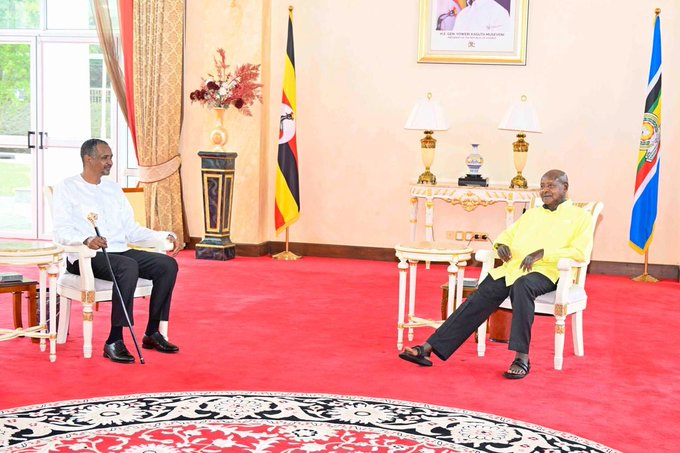
President Yoweri Museveni on Friday hosted Gen Mohamed Hamdan Dagalo, commander of Sudan’s paramilitary Rapid Support Forces (RSF), at State House Entebbe in a high-profile diplomatic engagement that underscores Uganda’s growing role in efforts to end Sudan’s protracted civil war.
Gen Dagalo, widely known as Hemedti, has been at the centre of Sudan’s violent power struggle since April 2023, when fighting erupted between the RSF and the Sudan Armed Forces (SAF). The conflict has since spiraled into one of Africa’s gravest humanitarian crises, displacing millions internally and across borders, and paralyzing key state institutions in Khartoum and beyond.
According to officials, Friday’s meeting focused on advancing dialogue as a pathway to de-escalation. President Museveni reiterated his long-held position that African conflicts require African-led political solutions anchored in negotiations rather than military confrontation. He has previously advocated for inclusive dialogue frameworks through regional mechanisms, warning against identity-based politics and external interference in domestic crises.
Gen Dagalo’s presence in Kampala marked a rare and symbolically significant diplomatic outing amid the ongoing hostilities in Sudan. In remarks shared by Ugandan officials, he thanked President Museveni for the hospitality and expressed interest in strengthening bilateral ties in trade, education and regional integration, even as conflict continues in his home country.
The engagement places Uganda at the intersection of humanitarian concern and strategic diplomacy. Since the outbreak of fighting, thousands of Sudanese refugees have sought safety in Uganda, adding pressure to an already stretched refugee-hosting system. Kampala has consistently positioned itself as a regional stabilizer, balancing its open-door refugee policy with efforts to prevent spillover instability from the Horn of Africa.
However, the meeting has also drawn scrutiny. International human rights organizations and Western governments have accused the RSF of grave abuses during the conflict, allegations the group has denied. Critics argue that high-level engagements risk conferring political legitimacy on armed actors without parallel accountability mechanisms, potentially complicating future peace efforts.
Ugandan authorities maintain that dialogue with all parties is essential for a sustainable settlement. Their approach broadly aligns with the positions advanced by the African Union and the Intergovernmental Authority on Development (IGAD), both of which have called for ceasefires and inclusive political processes to halt Sudan’s descent into further fragmentation.
Regional analysts say Uganda’s diplomatic outreach reflects a calculated attempt to assert influence in Horn of Africa peace processes. By engaging key actors directly, Kampala positions itself as a potential broker capable of facilitating communication channels that might otherwise remain closed.
Yet the risks remain considerable. Without tangible progress toward a ceasefire or a negotiated political roadmap, continued fighting in Sudan threatens to destabilize neighboring countries, fuel cross-border arms flows and intensify humanitarian pressures. For Uganda, prolonged instability could strain public resources and test domestic political tolerance for expanded refugee inflows.
As Sudan’s conflict enters another uncertain phase, Uganda’s engagement with Gen Dagalo signals both ambition and caution. Whether these overtures translate into measurable steps toward peace will depend not only on Kampala’s diplomatic leverage but also on the willingness of Sudan’s rival factions to priorities negotiation over battlefield gains.
ALSO READ: Museveni Urges Leaders to Persuade, Not Intimidate, in Janani Luwum Message.
