
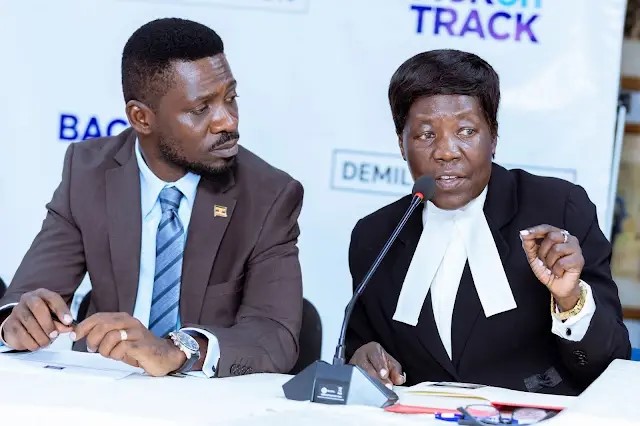
The decision by Robert Kyagulanyi Ssentamu, popularly known as Bobi Wine, to appoint Lina Zedriga Waru as acting president of the National Unity Platform (NUP) has sparked intense debate within Uganda’s political circles.
With four deputy presidents in the party structure, analysts say the choice of Zedriga was not accidental but rather a carefully calculated political decision influenced by experience, regional strategy, and internal party dynamics.
Within NUP’s leadership structure, each deputy president represents a specific region of Uganda. However, at the time Bobi Wine stepped aside temporarily, several factors made other deputies less suitable for the acting role.
For instance, Muhammad Muwanga Kivumbi, the deputy president for the central region, was facing serious legal challenges after being arrested following the 2026 elections. Kivumbi was detained on charges related to post-election violence, effectively removing him from active leadership duties at a critical time for the party.
In western Uganda, Jolly Jacklyn Tukamushaba had only recently joined the top leadership ranks of the party. Analysts note that her relatively short time in NUP’s national leadership meant she had not yet built the institutional authority required to temporarily lead the entire opposition party.
Meanwhile, John Baptist Nambeshe, another senior NUP figure and a Member of Parliament, already carries heavy responsibilities in Parliament and party mobilization. Political observers say assigning him the acting presidency could have overstretched his already demanding political workload.
With these limitations among the other deputies, Zedriga emerged as the most stable and available choice.
Another major factor behind Zedriga’s selection is her professional background.
Zedriga is not only a politician but also a lawyer, former magistrate, academic, and human-rights activist with extensive experience in governance and conflict resolution.
She holds multiple postgraduate qualifications in human rights and peace studies and has been involved in international initiatives related to justice and peacebuilding.
This strong institutional background gives her a level of credibility that is often rare in opposition politics, where leadership frequently depends more on popularity than governance expertise.
For Bobi Wine, analysts argue, placing someone with strong legal and diplomatic credentials at the helm of the party—even temporarily—helps strengthen NUP’s image as a serious national alternative to the ruling government.
Strategic Expansion into Northern Uganda
Another key strategic factor is regional politics.
Zedriga serves as NUP’s deputy president for Northern Uganda, a region that has historically been politically complex and often contested by different political movements.
Political observers say Bobi Wine may be using her appointment to deepen NUP’s influence in northern Uganda.
Zedriga herself has been deeply involved in grassroots mobilization and community work in the region, particularly in peacebuilding and women’s leadership initiatives.
Giving her the acting presidency sends a strong political signal that NUP is not just a Buganda-based movement but a national political force.
Another dimension often overlooked is gender representation.
When Bobi Wine first introduced Zedriga into the People Power leadership structure in 2020, it was partly to address concerns that the movement lacked female representation at the top level.
Her elevation to acting president therefore reinforces the party’s image as progressive and inclusive.
Analysts argue that this symbolism matters greatly for opposition movements trying to build broad national coalitions.
Zedriga has also demonstrated loyalty to Bobi Wine during some of NUP’s most difficult internal disputes.
During earlier leadership tensions involving former Leader of Opposition Mathias Mpuuga, she was among the leaders who stood firmly with the party’s central leadership and communicated controversial decisions taken by the National Executive Committee.
This reliability appears to have strengthened Bobi Wine’s trust in her ability to maintain party discipline during sensitive political moments.
Ultimately, Zedriga’s appointment reflects a combination of availability, experience, political strategy, and trust.
While the acting role is temporary, it highlights how leadership decisions inside NUP are shaped not only by hierarchy but also by political timing and regional considerations.
For Bobi Wine, choosing Lina Zedriga may therefore represent more than a simple delegation of authority—it may be part of a broader strategy to stabilize the party while expanding its national political footprint.
ALSO READ: Crackdown Intensifies: Third NUP Deputy President Arrested Following 2026 Polls
