

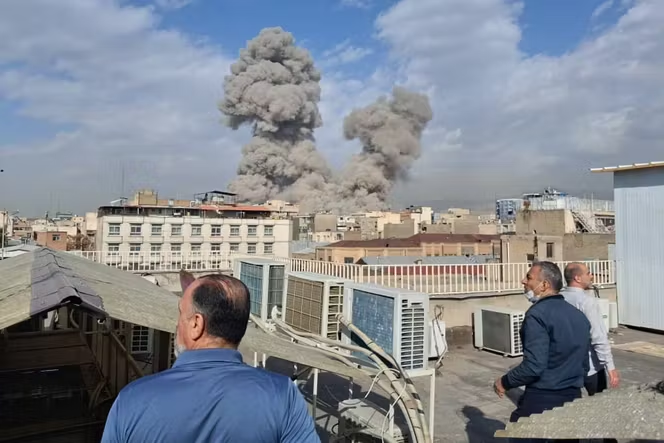
A major military confrontation erupted on Saturday after the United States and Israel launched coordinated air and missile strikes against Iran, dramatically escalating tensions in the Middle East and raising fears of a wider regional war. The operation, described by U.S. officials as a large-scale campaign against Iranian military and nuclear infrastructure, triggered swift retaliation from Tehran and prompted urgent international calls for restraint.
The joint offensive began in the early hours of February 28 when Israeli forces carried out what officials described as a pre-emptive strike, followed shortly by U.S. military involvement. Explosions were reported in several Iranian cities including Tehran and Isfahan, with smoke seen rising from targeted installations. The attacks form part of a coordinated military action known as “Operation Epic Fury,” while Israeli officials referred to the campaign as “Lion’s Roar.”
U.S. President Donald Trump confirmed that American forces had begun “major combat operations” in Iran, declaring that the objective was to eliminate threats posed by the Iranian government. He argued that Iran’s military activities and nuclear ambitions posed a direct danger to the United States and its allies.
In a video address, Trump urged Iranian security forces to lay down their weapons and called on citizens to “take over your government,” signaling that regime change could be an ultimate objective of the operation. He insisted that the strikes were necessary to protect American national security interests and prevent Iran from obtaining nuclear weapons.
The strikes followed weeks of rising tension and failed diplomatic negotiations over Iran’s nuclear programme. Washington had demanded that Tehran halt uranium enrichment, while Iran resisted calls to dismantle its nuclear capabilities. Trump had previously warned that military action remained an option if talks collapsed.
Iran responded quickly, launching missile attacks targeting Israeli territory and U.S. military bases across the region. Missiles were reported heading toward Israel and several Gulf states hosting American forces, including Qatar and Bahrain. Iranian authorities warned that further retaliation would follow.
Iran’s Foreign Ministry condemned the attacks as a violation of international law and vowed a “decisive” response, stating that the country was prepared to defend itself “with all their might.” Tehran also appealed to the United Nations Security Council to take action against what it described as aggression by the United States and Israel.
Inside Iran, the strikes triggered panic in major cities, with residents rushing to fuel stations and some families attempting to leave urban areas amid fears of prolonged fighting. Schools and public institutions were closed in several regions as authorities warned that further attacks could occur.
Israel has defended the operation as necessary to neutralize what it describes as an existential threat. Israeli officials said the attacks were aimed at preventing Iran from advancing its missile and nuclear capabilities and reducing the risk of future attacks against Israeli territory.
International reaction has been sharply divided. Russia condemned the strikes as an “unprovoked act of armed aggression,” warning that the escalation could trigger a broader humanitarian and economic crisis across the Middle East. Other governments have called for urgent diplomatic efforts to prevent further escalation.
Analysts warn that the conflict could expand beyond Iran and Israel, especially if Iranian-aligned groups across the region become involved. The attacks have already affected multiple countries where U.S. military bases are located, raising concerns that the confrontation could develop into a full-scale regional war.
Unconfirmed reports circulating on social media suggest that senior Iranian military figures may have been targeted and that additional waves of strikes could follow, though official casualty figures remain unclear. There are also claims that nuclear-related facilities were hit, which has heightened fears of environmental and humanitarian consequences if the conflict intensifies.
As military operations continue, the situation remains fluid and unpredictable. The latest escalation marks one of the most serious confrontations between the United States, Israel and Iran in recent years and could reshape the geopolitical balance in the Middle East.
ALSO READ: USS Abraham Lincoln on High Alert as US-Iran Tensions Spike; Possible Attack Looms
