

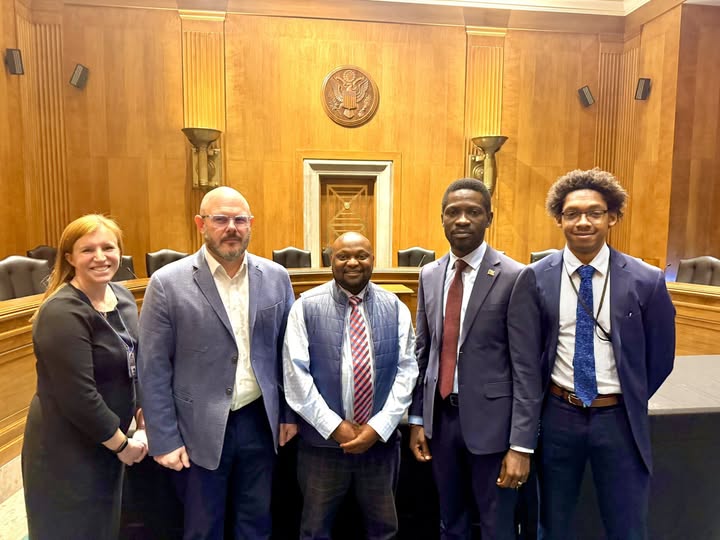
After days of uncertainty over his whereabouts, opposition leader Robert Kyagulanyi Ssentamu has resurfaced in Washington, D.C., marking a significant shift in his political approach and raising fresh questions about the implications for Uganda’s political landscape.
Mr Kyagulanyi, popularly known as Bobi Wine, confirmed his presence in the United States this week, revealing that he had commenced engagements with lawmakers on Capitol Hill.
“Started my international engagements today with meetings on Capitol Hill, in Washington DC,” he said in a brief statement that quickly ended speculation about his safety and location.
His re-emergence follows reports that he had quietly left Uganda amid alleged threats to his life linked to President Yoweri Museveni and his son, Muhoozi Kainerugaba.
The uncertainty surrounding his departure had sparked concern among supporters, while government-leaning voices dismissed the claims as politically motivated.
Now operating from Washington, Mr Kyagulanyi appears to be shifting focus from domestic mobilisation to international advocacy, targeting foreign governments and institutions.
The development builds on his earlier virtual address to the Geneva Summit for Human Rights and Democracy, where he called on international actors to impose sanctions on Uganda and reconsider financial support to the government.
With direct access to policymakers, analysts say his message could gain greater traction, particularly among actors concerned about governance and human rights.
The key question now is whether Mr Kyagulanyi’s international engagements will translate into tangible outcomes.
BREAKING: US Senator Jim Risch Calls for Tougher Action Against Uganda Over UPDF Conduct
Some political observers argue that sustained lobbying could result in increased diplomatic pressure on Kampala, including possible policy reviews by Uganda’s development partners.
Mr Kyagulanyi’s move signals an expansion of Uganda’s political contest onto the global stage, where issues of governance, democracy and human rights are increasingly scrutinized.
For his supporters, the strategy represents an opportunity to amplify their concerns internationally. For his critics, it raises questions about the effectiveness of seeking solutions outside the country.
As engagements continue in Washington, attention will turn to the response from both international actors and the Ugandan government.
While it remains unclear whether the efforts will yield immediate results, Mr Kyagulanyi’s re-emergence has already reshaped the narrative from a leader reportedly in hiding to one actively engaging global power centers.
For now, Ugandans are left to watch closely as the next phase of the country’s political contest unfolds beyond its borders.
ALSO READ: BREAKING: US Senator Jim Risch Calls for Tougher Action Against Uganda Over UPDF Conduct
